Abdominal aortic aneurysm - Medical practice variations - For a Healthy Belgium
←
→
Transcription du contenu de la page
Si votre navigateur ne rend pas la page correctement, lisez s'il vous plaît le contenu de la page ci-dessous
Vascular surgery - Abdominal aortic aneurysm

                Medical practice variations

               Abdominal aortic aneurysm

    Analysis of the distribution and evolution of medical practice in Belgium,
                 in terms of volume and expenditure per insured
(analysis and trends by region, province and district), over the period 2015-2017

 NIHDI – Healthcare Service – Directorate for Research, Development and Quality promotion
                                  Appropriate care unit
                       Pascal Meeus, Virginie Dalcq, Anneleen Van Geystelen
                           Contact: appropriatecare@riziv-inami.fgov.be

                              Date of report: 29 March 2019

                                                                                            1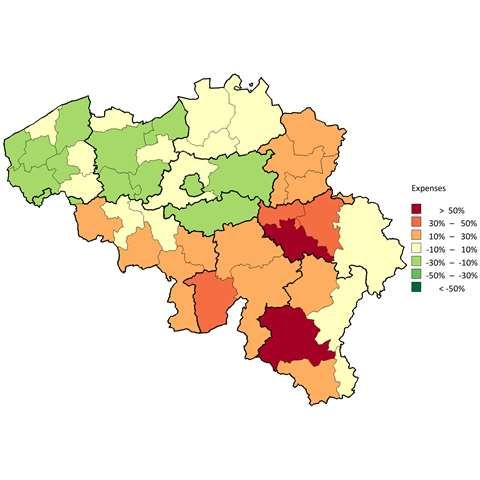
Vascular surgery - Abdominal aortic aneurysm

CONTENTS

CONTENTS ................................................................................................................................................................................................................................. 2

1.        INTRODUCTION ................................................................................................................................................................................................................. 3

2.        SPECIFIC METHOD OF ANALYSIS ........................................................................................................................................................................................ 4

     A.       NIHDI NOMENCLATURE CODES SELECTED FOR ANALYSIS....................................................................................................................................................................... 4
     B.       PAST HISTORY OF NOMENCLATURE CODES ......................................................................................................................................................................................... 5
     C.       SOURCE OF DATA .......................................................................................................................................................................................................................... 6
     D.       SPECIFIC SELECTION CRITERIA .......................................................................................................................................................................................................... 7
     E.       STANDARDISATION........................................................................................................................................................................................................................ 7

3.        RESULTS ............................................................................................................................................................................................................................ 8

     A.       NATIONAL STANDARDISED RATE OF USE............................................................................................................................................................................................. 8
     B.       BREAKDOWN OF NOMENCLATURE CODES PROVIDED, BY VOLUME ........................................................................................................................................................... 9
     C.       SPECIALISATION OF HEALTHCARE PROVIDERS .................................................................................................................................................................................... 10
     D.       SPECIALISATION OF PRESCRIBERS.................................................................................................................................................................................................... 11
     E.       STANDARDISED RATE OF USE BY GENDER AND AGE GROUP................................................................................................................................................................... 12
     F.       STANDARDISED RATE OF USE: HOSPITAL AND OUT-PATIENT CARE .......................................................................................................................................................... 16
     G.       STANDARDISED RATE OF USE BY REIMBURSEMENT RATE ...................................................................................................................................................................... 18
     H.       TRENDS IN STANDARDISED RATES OF USE ......................................................................................................................................................................................... 20
     I.       GEOGRAPHICAL VARIATIONS IN STANDARDISED RATES OF USE .............................................................................................................................................................. 23
     J.       STANDARDISED HEALTHCARE EXPENDITURE BORNE BY THE INSURANCE .................................................................................................................................................. 28

4.        KEY DATA SUMMARY ...................................................................................................................................................................................................... 31

                                                                                                                                                                                                                                                            2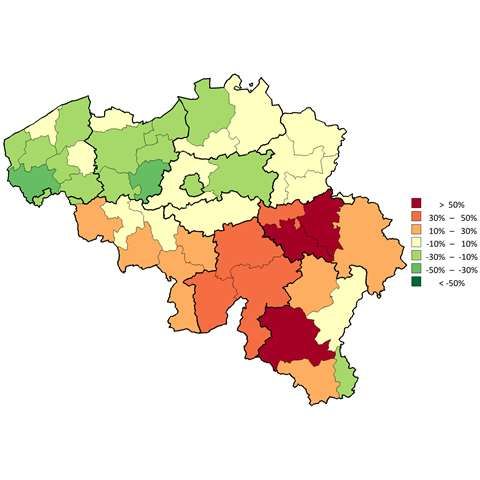
Vascular surgery - Abdominal aortic aneurysm

    1. INTRODUCTION

The Appropriate Care Unit was set up within the NIHDI’s Directorate for Research, Development and Quality under NIHDI’s Admin-
istration Contract for 2016-20181. Article 35 of this contract refers to ‘the setting up of an Appropriate Care Unit, aiming specifically
to promote an integrated approach to the rational use of resources’. The Appropriate Care Unit has been up and running since the
second quarter of 2017.

The tasks of the Unit were set out formally in the ‘2016-2017 Healthcare monitoring Action plan’, published by NIHDI on 18 July
20162. This plan lists around thirty measures designed to make healthcare provision more efficient, by encouraging appropriate
practice and tackling unnecessary or inappropriate care.

The plan states that one of the tasks of the Appropriate Care Unit is to analyse the ‘appropriateness of care’, in order to identify un-
explained variations in consumption patterns, identified after standardisation. Such variations can potentially point to non-optimal
use of resources.

‘Variations in medical practice’ documents report on the analyses carried out in this framework. Each report focuses on a particular
topic.

In this document, we present the figures and graphs relating to analyses3 of practice in the area of Abdominal aortic aneurysm, and
give the explanations necessary to understand these.

We have deliberately chosen not to attempt to interpret the figures, preferring to present the results to experts who are in a better
position to do so. This document has nevertheless been made available to the public in order to provide objective, open input to
discussions on this issue.

1
  (Institut national d'assurance maladie-invalidité, 2016)
2 (Institut national d'assurance maladie-invalidité, 2016)
3 Readers interested in the methodology used in these quantitative analyses should consult the document entitled ‘Variations in practice – Methodology’.

                                                                                                                                                           3
Vascular surgery - Abdominal aortic aneurysm
2. SPECIFIC METHOD OF ANALYSIS
A. NIHDI nomenclature codes selected for analysis
The NIHDI nomenclature codes selected for the analysis are listed below:
Outpatient Inpatient Used for rates ? Used for expenses ? Inclusive Exclusive Label Creation Deletion Group N Value
Chi rurgi e du ca rrefour a ortique en des s ous des
a rtères réna l es : rés ection du ca rrefour a ortique ,
237031 237042 yes yes 01-04-1985 N26 N750
pontages i ntra -a bdomi na ux bi l a téra ux,
enda rtérectomi es i l l i a ques bi l a téra l es
Chi rurgi e du ca rrefour a ortique en des s ous des
a rtères réna l es : rés ection du ca rrefour a ortique ,
pontages i ntra -a bdomi na ux bi l a téra ux,
enda rtérectomi es i l l i a ques bi l a téra l es , a s s oci ées
237053 237064 yes yes 01-04-1985 N26 N850
à une a utre recons truction va s cul a i re , à
l 'exception des i l l i a ques (pa r exempl e :
reva s cul a ri s a tion més entéri que , réna l e ou
fémora l e)
Chi rurgi e du ca rrefour a ortique en des s ous des
a rtères réna l es : rés ection du ca rrefour a ortique ,
pontages i ntra -a bdomi na ux bi l a téra ux,
237075 237086 yes yes 01-04-1985 N26 N1000
enda rtérectomi es i l i a ques bi l a téra l es , a s s oci ées
à une recons truction va s cul a i re mul tipl e , i l i a que
exceptée
Reva s cul a ri s a tion d'une s eul e a rtère a bdomi na l e
237090 237101 yes yes pa r enda rtérectomi e , endoa névri s morra phi e , 01-04-1985 N26 N600
pontage ou rés ection a vec greffe ou a na s tomos e
Impl a ntation percutanée d'une endoprothès e
s ous contrôl e d'i ma geri e médi ca l e pour l e
tra i tement d'un a névri s me a ortique a bdomi na l
a bdomi na l , ou pour l e tra i tement d'un a névri s me
de l 'a rtère i l l i a que de pl us de 3 cm, s a ns col l et
589595 589606 yes yes i l i a que proxi ma l , en ce compri s l es 01-09-2009 N51 I1850
ma ni pul a tions et l es contrôl es effectués penda nt
l e tra i tement et tout l e ma téri el util i s é , à
l 'exception des ca théters pour a ngi opl a s tie , des
endoprothès es , des produi ts pha rma ceutiques et
des moyens contra s te
This table shows the NIHDI nomenclature codes selected for this analysis, stating whether or not they were included in the analyses of services and expenditure, and
giving, for each one, a description, dates of creation and deletion, where appropriate, their N group (in the NIHDI nomenclature) and their value. 4Vascular surgery - Abdominal aortic aneurysm
B. Past history of nomenclature codes
Outpatient Inpatient Date Label Group N Value
Chirurgie du carrefour aortique en dessous des artères rénales : résection du carrefour aortique, pontages intra-
237031 237042 01-04-1985 N26 N750
abdominaux bilatéraux, endartérectomies illiaques bilatérales
Chirurgie du carrefour aortique en dessous des artères rénales : résection du carrefour aortique, pontages intra-
237031 237042 01-02-2016 N26 N750
abdominaux bilatéraux, endartérectomies illiaques bilatérales
Chirurgie du carrefour aortique en dessous des artères rénales : résection du carrefour aortique, pontages intra-
237053 237064 01-04-1985 abdominaux bilatéraux, endartérectomies illiaques bilatérales, associées à une autre reconstruction vasculaire, à N26 N850
l'exception des illiaques (par exemple : revascularisation mésentérique, rénale ou fémorale)
Chirurgie du carrefour aortique en dessous des artères rénales : résection du carrefour aortique, pontages intra-
237053 237064 01-02-2016 abdominaux bilatéraux, endartérectomies illiaques bilatérales, associées à une autre reconstruction vasculaire, à N26 N850
l'exception des illiaques (par exemple : revascularisation mésentérique, rénale ou fémorale)
Chirurgie du carrefour aortique en dessous des artères rénales : résection du carrefour aortique, pontages intra-
237075 237086 01-04-1985 abdominaux bilatéraux, endartérectomies iliaques bilatérales, associées à une reconstruction vasculaire N26 N1000
multiple, iliaque exceptée
Chirurgie du carrefour aortique en dessous des artères rénales : résection du carrefour aortique, pontages intra-
237075 237086 01-02-2016 abdominaux bilatéraux, endartérectomies iliaques bilatérales, associées à une reconstruction vasculaire N26 N1000
multiple, iliaque exceptée
Revascularisation d'une seule artère abdominale par endartérectomie, endoanévrismorraphie, pontage ou
237090 237101 01-04-1985 N26 N600
résection avec greffe ou anastomose
Revascularisation d'une seule artère abdominale par endartérectomie, endoanévrismorraphie, pontage ou
237090 237101 01-02-2016 N26 N600
résection avec greffe ou anastomose
Implantation percutanée d'une endoprothèse sous contrôle d'imagerie médicale pour le traitement d'un
anévrisme aortique abdominal infrarénal abdominal, ou pour le traitement d'un anévrisme de l'artère illiaque de
589595 589606 01-09-2009 plus de 3 cm, sans collet iliaque proximal, en ce compris les manipulations et les contrôles effectués pendant le N51 I2250
traitement et tout le matériel utilisé, à l'exception des cathéters pour angioplastie, des endoprothèses, des
produits pharmaceutiques et des moyens contraste
Implantation percutanée d'une endoprothèse sous contrôle d'imagerie médicale pour le traitement d'un
anévrisme aortique abdominal infrarénal abdominal, ou pour le traitement d'un anévrisme de l'artère illiaque de
589595 589606 01-06-2016 plus de 3 cm, sans collet iliaque proximal, en ce compris les manipulations et les contrôles effectués pendant le N51 I1850
traitement et tout le matériel utilisé, à l'exception des cathéters pour angioplastie, des endoprothèses, des
produits pharmaceutiques et des moyens contraste
Implantation percutanée d'une endoprothèse sous contrôle d'imagerie médicale pour le traitement d'un
anévrisme aortique abdominal abdominal, ou pour le traitement d'un anévrisme de l'artère illiaque de plus de 3
589595 589606 01-02-2018 cm, sans collet iliaque proximal, en ce compris les manipulations et les contrôles effectués pendant le traitement N51 I1850
et tout le matériel utilisé, à l'exception des cathéters pour angioplastie, des endoprothèses, des produits
pharmaceutiques et des moyens contraste
This table shows the history of the NIHDI nomenclature codes selected for analysis, as well as their past value and N group (in the NIHDI no-
menclature). If no changes have taken place over time, only the current information is shown.
5Vascular surgery - Abdominal aortic aneurysm
C. Source of data
The data used in the analyses have been taken from the following databases:
for the utilisation rate and amount of expenses of insured persons (who meet
Document N the selection criteria) whose age, sex, preferential regime and residence are
known 2007-2017
for the utilisation rate and amount of expenses of insured persons (who meet
Document P
the selection criteria) by type of medical specialities in 2015-2017
'N Documents' are monthly data sent by the sickness funds to NIHDI, within three months. These data show the number of services provided, dates and
the fees involved. Every six months, these data are compiled by the insurers, which also add data on patients: age, gender, social category and district of
residence. N Documents, however, cannot be used to analyse the combinations of services received by individual patients.
'P Documents' are six-monthly data sent by the sickness funds to NIHDI, within four months. These data show the services provided, the service-
provider, the prescriber, the place of provision of service, and the hospital where patients were treated. P Documents can be used to monitor medical
consumption and pricing, but not (yet) to analyse services per patient.
6Vascular surgery - Abdominal aortic aneurysm
D. Specific selection criteria
Several filters may have been applied to the data, so that only one section of the population is considered in analyses. If so, the fil-
ters used are shown in the table below:
FILTERS APPLIED TO DATA
Gender Women and men
Age All
E. Standardisation
The data are standardised before analysis per year, based on age, sex and preferential regime per arrondissement, province and re-
gion.
Standardisation renders populations comparable in relation to one or several criteria. If a difference is observed between these populations, we can
therefore assume that it is not due to the criteria covered by the standardisation process.
7Vascular surgery - Abdominal aortic aneurysm
3. RESULTS
A. National standardised rate of use
TOTAL
Average number of interventions per yea 2.581
Standardised rate of use
24
per 100,000 insured persons
8Vascular surgery - Abdominal aortic aneurysm
B. Breakdown of nomenclature codes provided, by volume
9Vascular surgery - Abdominal aortic aneurysm
C. Specialisation of healthcare providers
Specialisation of the provider Total providers Concerned providers % Providers Median of H.C. services Number of H.C. services % Total H.C. services Expenses % Expenses
General surgery 1325 261 20% 7,00 2.505,00 99% 3.375.859,14 99%
Other specialities 3474 8 0% 1,63 16,67 1% 25.212,17 1%
Total 4799 269 6% 7,00 2.521,67 100% 3.401.071,31 100%
This table shows the following non-standardised data, by medical specialities (average figures for the period 2015-2017) :
- The number of service-providers per specialisation who have recorded at least one service falling within the N group(s) (of the NIHDI nomen-
clature) covered by this analysis;
- The number of service-providers recording services under the nomenclature codes selected for this analysis;
- The service-providers for these codes as a percentage of the total number of service-providers recording provision of at least one service fall-
ing within the N group(s) (of the NIHDI nomenclature) covered by this analysis;
- The median number of services per service-provider (recording provision under these codes);
- The number of services provided;
- The service percentage, i.e. the number of services recorded for this specialisation as a percentage of total services provided;
- Expenditure;
- The expenditure percentage, i.e. the expenditure on this specialisation as a percentage of total expenditure.
10Vascular surgery - Abdominal aortic aneurysm
D. Specialisation of prescribers
Specialisation of the prescriber Total prescribers Concerned prescribers % Prescribers Median of prescriptions Number of prescriptions % Prescriptions Expenses % Expenses
Unknown 2 1 43% 2.521,67 2.521,67 100% 3.401.071,31 100%
Total 2 1 43% 2.521,67 2.521,67 100% 3.401.071,31 100%
This table shows, in order, the following non-standardised data per specialities (average figures for the period 2015-2017) :
- The number of prescribers who have prescribed at least one service falling within the N group(s) (of the NIHDI nomenclature) covered by this analysis;
- The number of prescribers prescribing the nomenclature codes selected for this analysis;
- The prescribers prescribing these codes as a percentage of the number of prescribers prescribing at least one service falling within the N group(s) (of the
NIHDI nomenclature) covered by this analysis;
- The median number of services per prescriber (prescribing these codes);
- The number of services prescribed;
- The percentage of services prescribed, i.e. the number of prescriptions issued for this specialisation as a percentage of total services prescribed;
- Expenditure;
- The expenditure percentage, i.e. expenditure on this specialisation as a percentage of total expenditure.
11Vascular surgery - Abdominal aortic aneurysm
E. Standardised rate of use by gender and age group
TOTAL
Average number of interventions per year 2.581
Median age (years) 71
Mean age (years) 70,81
Max/Min Ratio of the median age
1,14
(by district)
Percentage of women 16,37%
Max/Min Ratio:
The max/min ratio measures the dispersion of values. It is calculated as the ratio of the maximum value found
for the variable, in all districts, to the minimum value. If this minimum value is equal to zero, the max/min ratio
cannot be calculated, and should be given as ‘NA’ (‘not applicable’).
12Vascular surgery - Abdominal aortic aneurysm
This figure is made up of bar
charts for each gender. The
coefficient of variation, shown by
the red line, measures the rela-
tive dispersion of the standard-
ised rates of use observed for
each district, by age group and
gender (standard deviation
divided by the mean). This line is
shown in bold for age groups
where the variation coefficient
can be validly interpreted (i.e.
for age groups in which there
are sufficient insured persons
per district to allow for a proper
comparison).
The left-hand vertical axis of the
graph plots the standardised
rate of use, and the right-hand
axis plots the variation coeffi-
cient. The horizontal axis shows
the division by age group. The
horizontal dotted lines show the
total values of the standardised
rates of use (in blue) and of the
variation coefficient (in red).
Standardised rate of use per 100,000 insured persons, and variation coefficient for the districts, by age
group and gender, for the year 2017
13Vascular surgery - Abdominal aortic aneurysm
Comparison of the standardised rates of use for women and men (per 100,000) in 2017
14Vascular surgery - Abdominal aortic aneurysm
This histogram shows standard-
ised rates of use by province and
by gender. The grey bars show
the rates for men, while the
green bars show the rates for
women, for each province. The
grey and green broken lines
show the total standardised
rates of use, again grey for men,
green for women.
Standardised rate of use per 100,000 insured persons, by gender and by province for the year 2017
15Vascular surgery - Abdominal aortic aneurysm
F. Standardised rate of use: hospital and out-patient care
TOTAL
Average number of interventions per year 2.581
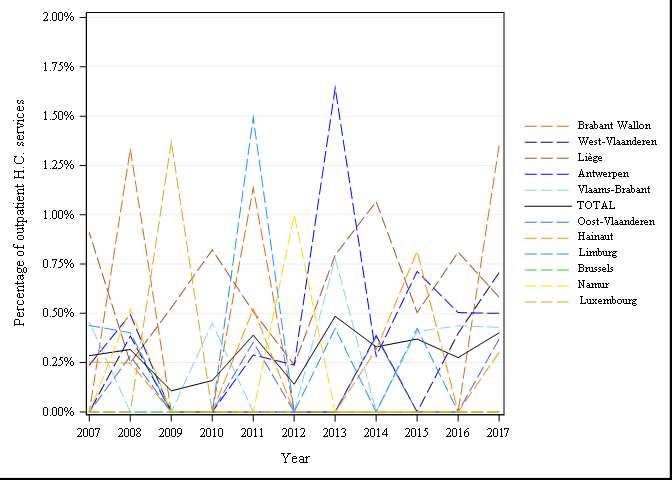
Percentage of out-patient care 0,35%
Max/min ratio of out-patient care percentage
NA
(by district)
This graph shows the per-
centage of out-patient ser-
vices (including hospital day
admissions), i.e. the number
of out-patient services pro-
vided as a percentage of total
services (out-patient + hospi-
tal stays). As well as one bar
per region, there is a bar for
the whole Belgian population.
This overall ratio is also
shown by a dotted line.
Percentage of out-patient care, total and by region
16Vascular surgery - Abdominal aortic aneurysm
Change over time in the percentage of out-patient care, by province
17Vascular surgery - Abdominal aortic aneurysm
G. Standardised rate of use by reimbursement rate
TOTAL
Average number of interventions per year 2.581
Percentage provided under the preferential reimbursement rate 26,67%
Standardised rate of use with preferential reimbursement rate
35
(per 100,000)
Standardised rate of use without preferential reimbursement rate
21
(per 100,000)
Ratio Preferential rate /General rate 1,65
18Vascular surgery - Abdominal aortic aneurysm
This graph shows the stand-
ardised rate of use with (in
red) and without (in grey) the
preferential reimbursement
rate, by region and in total.
The red and grey dotted lines
show the overall standardised
rates of use, with and without
the preferential reimburse-
ment rate, respectively.
Standardised rate of use by reimbursement rate and by region
19Vascular surgery - Abdominal aortic aneurysm
H. Trends in standardised rates of use
TOTAL
Average number of interventions per year 2.581
Trend (2007-2017) -1,77%
Trend (2015-2017) -4,49%
This graph shows a coloured
curve for each region and a
black curve for the whole
Belgian population. The x-axis
shows the years, and the y-axis
shows the standardised rate of
use per 100,000 insured per-
sons.
Trends in the standardised rate of use per 100,000 insured persons, by region
20Vascular surgery - Abdominal aortic aneurysm
This graph shows a coloured
line for each district and a
black line for the whole Bel-
gian population. The x-axis
shows the years, and the y-
axis shows the standardised
rate of use per 100,000 in-
sured persons.
To better highlight changes
over time, the rates shown
are rolling averages of the
rates for the three years pre-
ceding the year in question
(including the year itself).
The graph only shows the 5
districts with the highest
average rates, and the 5 dis-
tricts with the lowest average
rates over the last 3 years
studied.
Trends in the standardised rate of use per 100,000 insured persons, by district
21Vascular surgery - Abdominal aortic aneurysm
Rate This table shows the standardised rates of use (or of
Annual increase
of use intervention) for the last year analysed (2017), but
2017 also the average rates of increase, by province, by
2007- 2015- Statistical region and in total, for the longer period (2007-
(per 105
2017 2017 significance 2017) and the shorter period (2015-2017).
insured)
West Flanders 20,72 0,09% 0,36% The statistical significance has been calculated to
show whether the change in data over the last
East Flanders 17,83 -2,22% -6,79% three years of the period analysed differs from the
Antwerp 21,85 -1,16% -2,48% change over the whole period, by province and by
region. Linear regressions have therefore also been
Limburg 23,21 -2,56% -7,66% *** used. This method calculates a regression line by
21,16
Provinces
Flemish Brabant 0,22% -4,14% * period studied (2007-2017 and 2015-2017). The
slope of this line is the regression coefficient. The
Brussels 20,05 -0,97% -4,42% statistical significance reflects the size of the differ-
Walloon Brabant 20,72 -4,50% 1,30% ence between the regression coefficients in the
various periods analysed, i.e. whether or not trends
Hainaut 26,03 -2,28% -4,99% ** have changed.
Liège 32,21 -3,03% -7,72% ***
The asterisks show the degree of statistical signifi-
Namur 27,66 -3,11% -4,05% cance of the data observed, with the following
Luxembourg 28,57 -1,14% 0,62% *** values: * Value from p ≤ 0.05 / ** Value from p ≤
Flanders 20,65 -1,10% -3,93% 0.01 / *** Value from p ≤ 0.001. If there is no aster-
Regions
isk, the trend observed is not statistically signifi-
Brussels 20,05 -0,97% -4,42% cant.
Wallonia 27,62 -2,81% -5,14%
‘NA’ is shown where the nomenclature codes se-
TOTAL 22,89 -1,77% -4,49% ** lected for the analysis have not been used for the
whole of the three-year period.
Trends in the rates of use, by province and region
22Vascular surgery - Abdominal aortic aneurysm
I. Geographical variations in standardised rates of use
TOTAL
Average number of interventions per year 2.581
Coefficient of Variation (2015-2017) 26,29
Max/Min Ratio* of the standardised rates of use
1,45
(by region)
Max/Min Ratio* of the standardised rates of use
2,96
(by district)
Coefficient of Variation (2015-2017) 26,29
Coefficient of Variation (2007-2009) 29,31
Statistically significant difference? (p-value) No (0,513)
* An ‘NA’ result indicates a ratio which cannot be calculated, i.e. the minimum value = zero (cf. E. Standardised rate of use by gender and age
group)
23Vascular surgery - Abdominal aortic aneurysm
A dot plot is a distribution chart
which is useful for highlighting
grouped data, gaps in distribu-
tion and outlying values. Here,
each dot represents the rate of
use of a district, for its whole
population or broken down by
gender.
The rates are rounded to the
nearest unit, ten, hundred,
etc., depending on the value of
the maximum rate, in order to
better group the values.
The graph also shows, as ‘box-
es’, the 25th, 50th and 75th per-
centiles of the non-rounded
standardised rates of use for all
patients. The bottom line of
the box represents the 25th
percentile, while the upper line
represents the 75th percentile.
The line inside the box repre-
sents the 50th percentile.
‘Dot plot’ showing standardised rates of use by district, by gender
24Vascular surgery - Abdominal aortic aneurysm
On this map of Belgium, the
boundaries of the districts are
shown by thin lines, while the
provincial borders are shown by
thick lines. The districts are col-
oured using a colour scale based
on the level of rate of use in the
district compared to the Belgian
average. This comparison is ex-
pressed as a percentage: e.g. 0%
if the district rate is equal to the
overall rate, 20% if the rate is
20% above the total rate, and -
20% if the rate is 20% below the
overall rate. The percentages are
calculated using the mean stand-
ardised rate of use of the last
three years, and are displayed in
bands of 20%. The following
colour coding applies:
Colour Category
More than 50%
Between 30% and 50%
Between 10% and 30%
Between - 10% and 10%
Between -30% and -10%
Between -50% and - 30%
Less than -50%
No use made
Map showing distribution of standardised rates of use, by district
25Vascular surgery - Abdominal aortic aneurysm
On this map of Belgium, the
boundaries of the districts are
shown by fine lines, while the
provincial borders are shown by
thick lines. The districts are col-
oured using a colour scale based
on the level of expenditure in the
district compared to Belgian
average expenditure. This com-
parison is expressed as a per-
centage: e.g. 0% if expenditure in
the district is equal to the overall
expenditure, 20% if it is 20%
higher, and -20% if it is 20% low-
er. The percentages are calculat-
ed using the mean standardised
expenditure for the last three
years and are displayed in bands
of 20%. The following colour
coding applies:
Colour Category
More than 50%
Between 30% and 50%
Between 10% and 30%
Between - 10% and 10%
Between -30% and -10%
Between -50% and - 30%
Map showing distribution of standardised expenditure, by district Less than -50%
No expenditure
26Vascular surgery - Abdominal aortic aneurysm
In this graph, the standardised rate of
use in a district is placed according to
the size of its population. As well as
the dots for districts, the confidence
intervals (expected variation in the
standardised rate of use when the only
source of variation is random) are also
shown on the graph (horizontal per-
centile lines). These are independent
of the size of the districts. The thicker
horizontal line shows the national
standardised rate of use. The outlier
districts are indicated by values above
P90 and below P10.
As long as the practice analysed only
occurs once per year per insured, this
graph can also be interpreted as a
funnel plot. The confidence levels here
are typically shaped like a funnel: for
small population-sizes, the expected
variation is larger than for more popu-
lous districts. The curves shown by
broken lines represent the 95% and
99.7% confidence intervals. The dis-
tricts situated beyond the upper and
lower limits of the 99.7% confidence
levels are defined as ‘outliers’
‘Funnel plot’ showing the distribution of standardised rates of use by district,
by number of insured persons
27Vascular surgery - Abdominal aortic aneurysm
J. Standardised healthcare expenditure borne by the insurance
TOTAL
Average number of interventions per year 2.581
Average annual expenditure (€) 3.514.518
Average cost per intervention (€) 1361,51
Average annual expenditure per insured (€) 0,32
Max/Min Ratio* of expenditure per insured
1,45
(by region)
Max/Min Ratio* of expenditure per insured
2,52
(by district)
* An ‘NA’ result indicates a ratio which cannot be calculated, i.e. the minimum value = zero (cf. E. Standardised rate of use by gender and age
group)
28Vascular surgery - Abdominal aortic aneurysm
Standardised expenditure
(per insured)
West Flanders 0,27 €
East Flanders 0,24 €
Antwerp 0,3 €
Limburg 0,31 €
Provinces
Flemish Brabant 0,28 €
Brussels 0,27 €
Walloon Brabant 0,25 €
Hainaut 0,34 €
Liège 0,41 €
Namur 0,37 €
Luxembourg 0,38 €
Flanders 0,28 €
Regions
Brussels 0,27 €
Wallonia 0,36 €
TOTAL 0,3 €
Regional and provincial distribution of standardised expenditure (2017)
29Vascular surgery - Abdominal aortic aneurysm
Nomenclature 2007 2008 2009 2010 2011 2012 2013 2014 2015 2016 2017 Average annual growth rate
237031-237042 915,53 931,32 967,03 979,53 981,72 998,38 1.017,70 990,44 942,80 1.025,62 1.034,50 1,23%
237053-237064 1.031,99 1.041,07 1.078,72 1.106,47 1.105,60 1.123,52 1.137,72 1.122,93 1.064,60 1.160,31 1.173,33 1,29%
237075-237086 1.222,36 1.244,06 1.292,12 1.306,15 1.318,39 1.330,68 1.343,77 1.330,00 1.251,43 1.378,68 1.391,25 1,30%
237090-237101 680,90 701,75 729,73 737,35 721,04 752,26 753,99 737,15 701,27 761,79 739,20 0,82%
589595-589606 0,00 0,00 0,00 1.747,82 1.769,47 1.680,53 1.691,75 1.710,74 1.712,55 1.624,55 1.440,20 -2,73%
Change over time in expenditure, by service and by nomenclature code
30Vascular surgery - Abdominal aortic aneurysm
4. KEY DATA SUMMARY
TOTAL
Main healthcare providers
General surgery 99,00%
Main prescribers
Unknown 100,00%
Standardised rate of use
Average number of interventions per year 2.581
Standardised rate of use per 100,000 insured persons 23,81
Median age (years) 71
Max/min ratio* of the median age (by district) 1,14
Percentage of women 16,37%
Percentage of out-patient care 0,35%
Ratio Preferential rate/General rate 1,65
Trends
Trend (2007-2017) -1,77%
Trend (2015-2017) -4,49%
Statistically significant difference? (p-value) Yes (0,004)
Geographical variations
Coefficient of Variation (2015-2017) 26,29
Coefficient of Variation (2007-2009) 29,31
Statistically significant difference? (p-value) No (0,513)
Max/min Ratio* of number of interventions
1,45
per 100,000 insured persons (by region)
Max/min Ratio* of number of interventions
2,96
per 100,000 insured persons (by district)
Standardised expenditure
Average annual expenditure (€) 3.514.518
Average annual expenditure per insured (€) 0,32
Max/Min Ratio* of expenditure per insured (by region) 1,45
Max/Min Ratio* of expenditure per insured (by district) 2,52
Average cost of interventions (€) 1361,51
* An ‘NA’ result indicates a ratio which cannot be calculated, i.e. the minimum value = zero
(cf. E. Standardised rate of use by gender and age group)
31Vous pouvez aussi lire


